
By Johan Vartanian · SEO & CRO Specialist at Billetto · Last updated 6 October 2026
Johan helps European event organisers grow their audience through search and conversion optimisation. 5+ years in SEO across marketplaces and content sites.
Quick answer
- Sweet spot: 60–200 guests for adult club-style events, 30–80 for family-friendly formats, 3–5 hours.
- Typical cost to run: £600–£4,500. Ticket price: £8–£35 (family) or £15–£45 (adult), premium themed events £45–£95.
- Open ticket sales 4–6 weeks before. Halloween has the most compressed sales window of the year (60% of tickets sell in the final week).
- Alcohol requires a Premises Licence at the venue or a Temporary Event Notice (£21, at least 10 working days ahead).
- Costume competition with a proper prize (£100+ voucher) lifts booking conversion by 15–25% and drives Instagram content that markets next year's event.
Halloween has a special place in the UK event calendar. It's the format where a middle-of-the-road venue can suddenly sell out in a week, where a mediocre DJ becomes memorable behind a mask, and where a bar's monthly takings can double in a single evening. The upside is real. So is the downside: half the city is running Halloween events, and audiences filter fast on theme, price, and social proof.
The most common trap for first-time organisers is under-committing to the theme. A pub with a couple of pumpkins by the door isn't a Halloween party. It's a pub with pumpkins. The events that fill are the ones where the venue is transformed, the staff are in costume, and the guests know they can arrive in full costume without feeling silly. This guide walks through how to build one that fills.
What is a Halloween party?
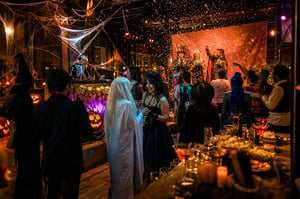
A Halloween party is a themed social event, typically 3–5 hours, where guests attend in costume, the venue is decorated to match a horror or gothic theme, and the programme usually includes music, food, drinks, and often a costume competition. Formats range from family-friendly afternoon events (30–80 guests, 15:00–18:00) to adult club-style evenings (60–200 guests, 20:00–02:00).
Halloween works commercially because it converts audiences that don't normally attend ticketed events. A pub can sell 150 tickets at £20 to guests who'd never pay for a normal Saturday night. The seasonal window is what makes it work: the same event in March wouldn't sell 30.
How much does it cost to host a Halloween party?
A 120-guest Halloween party in London or Manchester typically costs £1,500–£4,000 to produce. Here's a typical breakdown:
| Line item | Typical cost | Notes |
|---|---|---|
| Venue (evening, 120 people) | £300–£1,200 | Often free if venue keeps bar revenue |
| Decoration and props | £200–£800 | Pumpkins, cobwebs, dry ice, lighting |
| DJ or live music | £250–£800 | 4–5 hour set |
| Costume prizes | £100–£500 | Vouchers or premium spirits |
| Photo booth or photographer | £200–£600 | Fuel for next year's marketing |
| Themed food/snacks | £3–£8 per guest | If provided (often optional) |
| Marketing | £150–£600 | Instagram Ads, Facebook, partner channels |
| Ticketing fees | ~3% of ticket price | Standard Billetto fee structure |
At £20 a ticket, 120 sales bring in £2,400 against £1,800 in costs, a margin of £600. If the venue also shares bar revenue (typically £8–£15 profit per guest on a Halloween night), total gross can reach £3,500–£4,500. For broader benchmarks, see our overview of event costs.
How to plan a Halloween party, step by step
- Pick a specific theme. "Vintage horror movie night", "Vampire ball" or "Family Halloween carnival" beats "Halloween party" every time. The theme is your marketing.
- Choose the audience tightly. Adult club-style (18+), family-friendly (all ages, ends 20:00), or students. Mixing them kills the atmosphere.
- Book venue and DJ 5–6 weeks ahead. Everyone else is trying to book the same weekend, so start early.
- Commit to decoration. Budget at least £3–£6 per guest on decor. Half-hearted decoration is worse than none, and guests notice.
- Set up a costume competition with real prizes. £100+ voucher for best costume, £50 for best group. Runners-up prizes for effort. Announce the prize structure on the landing page.
- Price the tickets. See formula below.
- Build the landing page with atmosphere. Dark colours, theme photos from previous years (if you have any), what's included, dress code, prize details.
- Open ticket sales 4–6 weeks before. Halloween sales are extremely compressed, so expect 60% of tickets to sell in the final week.
- Market aggressively in October. Instagram Ads targeting local users 20–45 with interest in themed events. Boost 2 weeks out and escalate in the final week.
- Send a reminder email 48 hours before. Address, dress code, prizes, door timings, what's included.
- Run the event with clear phases. Doors and warm-up (60 min), main programme with costume comp (90 min), open party (rest of the night). Announce the costume winner around 22:00 when the room is full.
- Follow up within 48 hours. Thank-you email, photo gallery, Save the Date for next year's event. This is how you build a recurring seller.
Choosing a venue for your Halloween party
The best Halloween venue already holds a Premises Licence and has an atmosphere that transforms with decoration (avoid brightly lit sports bars), a stage or clear area for the costume competition, and a bar that can handle 120+ orders in an evening. Warehouse spaces, gothic pubs, cocktail bars with mezzanines, and small nightclubs all work well.
Budget £300–£1,200 for a 5-hour evening rental for 120 people. Many venues waive room hire on Halloween in exchange for a bar minimum, so negotiate a bar spend commitment (typically £1,500–£3,000) rather than paying room hire outright.
How to price your tickets
The pricing formula for Halloween parties:
Ticket price = (venue + music + decoration + prizes per guest) × 2
Halloween has lower multipliers than most event types because bar revenue is the venue's main income and the ticket price needs to be low enough to fill the room.
Worked example: venue £4 per guest (£480 ÷ 120), DJ £4, decoration £3, prizes £2. Total £13 × 2 = £26, rounded down to £20 advance / £30 on the door.
Use two tiers: Early Bird (£15, cutoff 3 weeks before) and Standard (£20). Door price should be 40–60% above advance to drive advance sales.
Setting up ticket sales for your Halloween party
The right ticketing platform for Halloween handles three things: fast mobile purchase (Halloween tickets sell late at night from the sofa), card payments with Visa and Mastercard, and QR check-in that works in low light with people in masks.
Fast mobile purchase is decisive, because the last-week rush brings late impulse buyers. Billetto lets buyers complete their purchase in under 15 seconds. QR check-in works even in low light. Payment: Mastercard and Visa are standard. Two other Billetto details: no listing fees, and attendee data to market next year's Halloween party to the same audience.
Promoting your Halloween party
Halloween marketing is compressed into a 3–4 week window. Our event marketing timeline is the general framework, but for Halloween specifically:
Instagram and TikTok dominate. Reels and Stories showing decoration progress, staff testing costumes, previous years' photos. Bright, warm designs blend into the feed, while dark, atmospheric ones stand out.
Facebook Events still work for Halloween, especially for local family and student audiences. Set up 3–4 weeks out.
Local Halloween round-ups. Time Out, local newspapers and city event pages all publish "best Halloween parties in [city]" lists. Reach out 3 weeks ahead with a press-friendly pitch.
Legal and licensing considerations
- Alcohol licensing. If serving alcohol, the venue needs a Premises Licence, or you'll need a Temporary Event Notice (£21, at least 10 clear working days ahead, fewer than 500 people at any time including staff).
- Age restrictions. Adult events should be clearly marked 18+ at ticket purchase and enforced at the door.
- Public liability insurance. Event policies start from £15 for a single night, essential given Halloween's higher-than-average incident rate.
- Fire safety. If using candles, dry ice, or pyrotechnics for effects, check with the venue's fire safety officer.
- Music licensing. If playing recorded music, the venue should already hold a PPL/PRS licence.
Frequently asked questions
How far in advance should I open ticket sales?
4–6 weeks. Halloween has extremely compressed sales, with 60% of tickets moving in the final week.
Should costumes be mandatory?
Encourage costumes strongly, but don't require them. Guests who arrive without costume feel awkward and often don't return the next year. Signal the expectation clearly on the landing page and in the reminder email.
What size prize should I offer for the costume competition?
£100+ for the winner is the threshold that generates real effort and Instagram content. Below that, most guests don't bother competing.
What's a typical no-show rate?
8–15% for Halloween, lower than most late-night events, because the effort of dressing up creates commitment.
Should I take payment at the door?
Yes, but make the door price 40–60% above advance. Halloween attracts impulse walk-ins, but you want to drive advance sales for planning.
Related guides
- How to host a comedy night, another evening entertainment format.
- How to host a networking event, a similar social format.
- How much does it cost to organise an event in 2026?, broader cost benchmarks.
- Event marketing timeline, the full promotion schedule.
Start selling tickets to your Halloween party
Billetto makes it simple to sell tickets to a Halloween party with Early Bird and Door tiers, Visa and Mastercard checkout, and QR check-in that works in low light. Create event on Billetto and have ticket sales live the same day.
